
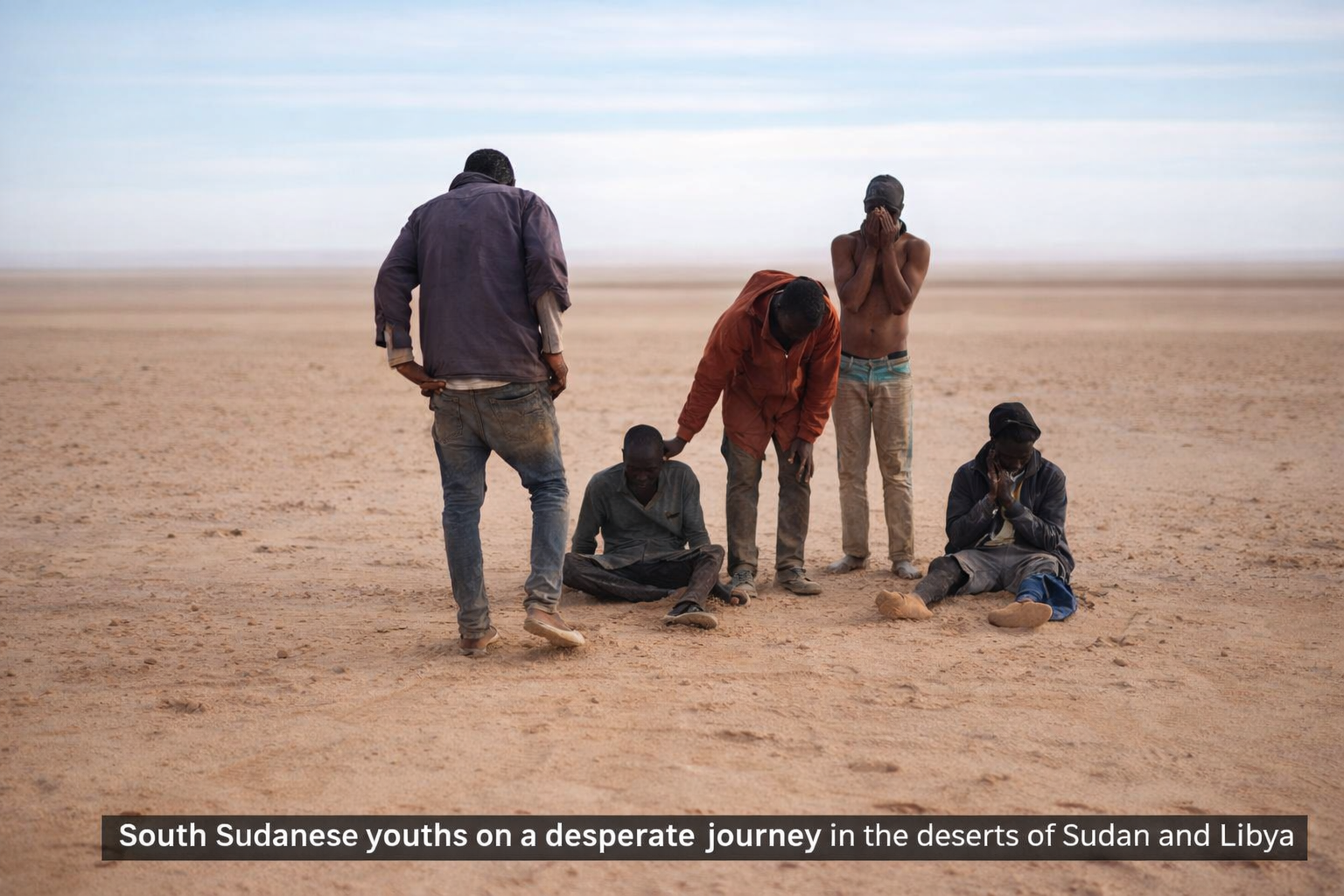
More than five years ago, I interviewed young South Sudanese who had left the country through Egypt, North Sudan, and the desert routes leading into Libya. Their accounts were not stories of opportunity. They were reflections shaped by dehydration, violence, disappearance, and systematic exploitation. Some of those young people did not survive the desert. Others became trapped in conditions resembling enslavement. Several were never heard from again.
One statement from those interviews remains deeply troubling: there was nothing left behind to return to. That perception, whether accurate or not, continues to shape the decisions of many young South Sudanese today.
I write this as someone who has lived in the West, observed migration systems in Australia, Europe, and the United States, and who has also recently returned from South Sudan. The hardship at home is real and visible. Yet the irregular migration route through Libya and across the Mediterranean is not a practical alternative to hardship. It is a high-risk corridor marked by criminal networks, legal uncertainty, and extreme vulnerability.
The first danger lies in the desert route itself. Movement across the Sahara is largely organised through smuggling networks operating without accountability. Individuals are transported in unsafe conditions, often without sufficient water, food, or medical care. Those who fall ill or cannot pay may face abandonment or forced labour. International human rights monitors have documented serious abuses within Libyan detention environments, including violence, extortion, and degrading treatment of migrants.
The second danger is the Mediterranean crossing. Despite awareness campaigns, thousands of migrants continue to die or go missing at sea each year. Boats are frequently overloaded and unseaworthy. Rescue is never guaranteed, and identification of the dead is often impossible. Families in South Sudan and across the region are left without confirmation, closure, or remains to bury. The sea has become an unmarked grave for many young Africans whose journeys ended before reaching safety.
Arrival in Europe does not necessarily resolve these risks. For migrants who reach European shores without valid documentation, legal insecurity becomes a defining reality. Identity verification can take years. During this period, individuals may be placed in reception centres or detention facilities, some of which have been criticised by independent monitors for overcrowding and poor conditions. In parts of Eastern Europe, including Bulgaria, monitoring bodies have reported standards that fall below acceptable humanitarian expectations.
Beyond detention, many migrants face prolonged homelessness, informal labour, and social isolation. Official figures from Western Europe show an increasing presence of non-citizens among rough sleepers in major urban centres where housing shortages are severe. These realities rarely appear in the narratives circulated online, where selective success stories shape public perception. The visible stories of success often overshadow the quieter experiences of those who struggle, wait for documents, or remain trapped in uncertainty.
This gap between perception and reality has become one of the most powerful drivers of irregular migration. Success is visible. Failure is silent. Those who die, disappear, or remain in legal limbo rarely shape the narrative, yet they represent a significant part of the journey’s outcome.
This issue demands a serious and coordinated response from South Sudanese institutions. Public sensitisation must move beyond slogans and address concrete risks such as trafficking, debt bondage, detention, and long-term legal insecurity. Migration should be approached as a protection and governance issue, not merely an individual decision. Young people deserve accurate information, viable opportunities at home, and lawful mobility pathways where they exist.
This article is not written to condemn those who leave. It is written to assert that the loss of young lives through preventable routes is a national concern. A country not only loses its future through conflict. It can also lose it quietly, through deserts, detention centres, and unmarked waters. Addressing this reality is not an act of pessimism. It is an obligation of leadership, law, and conscience.