
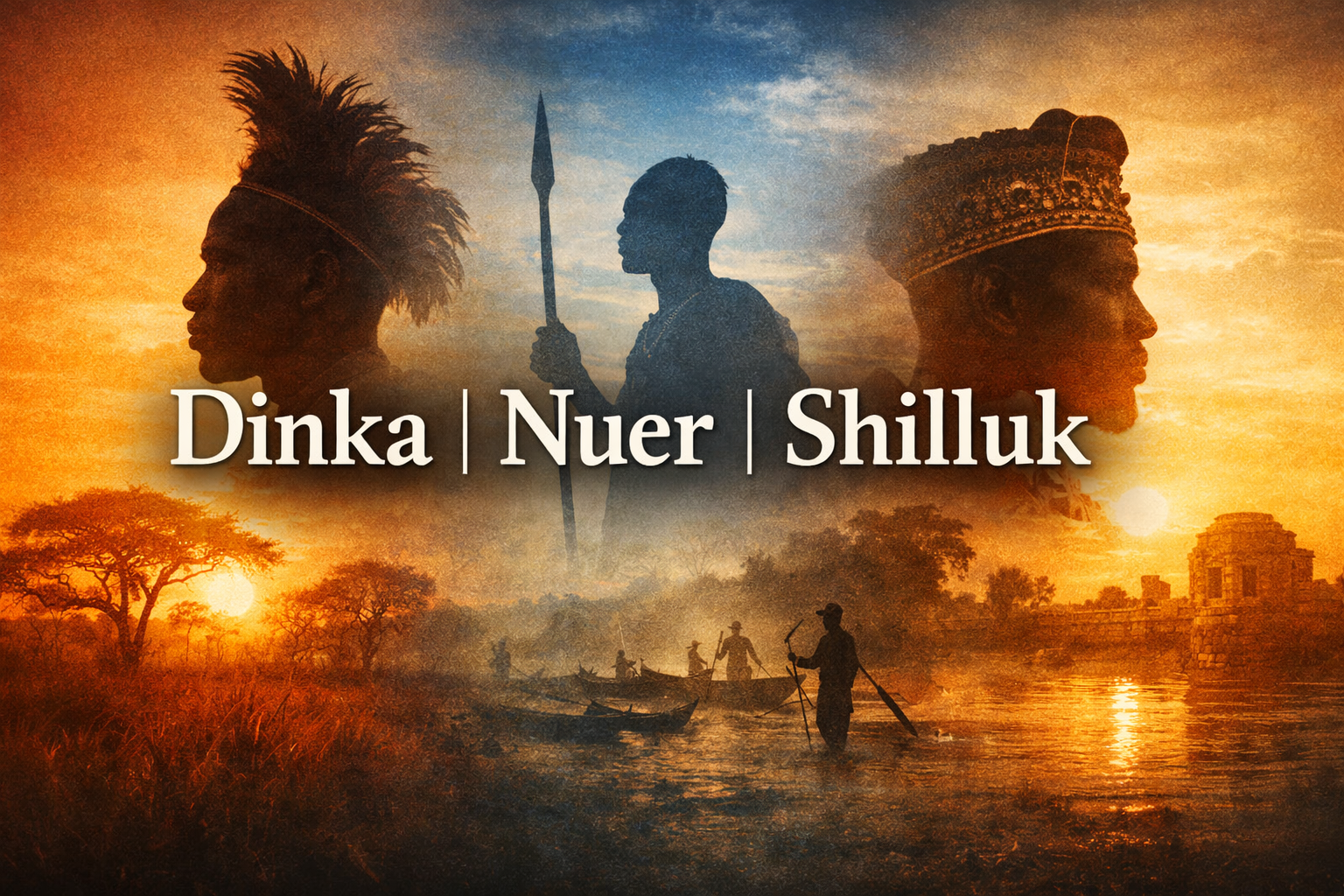
I write this reflection with respect and clarity of intention. It is not addressed against any community, nor does it seek to elevate one people above another. Rather, it speaks to a political reality that deserves honest examination. Many of the most visible political voices in South Sudan today emerge from Dinka, Nuer, and Shilluk heritage. Acknowledging this reality does not diminish the dignity or contribution of other communities. It recognises influence, and with influence comes responsibility.
The concern before us is not identity itself, but perception. When political debate begins to appear as a contest between prominent communities, the wider national imagination narrows. Citizens from smaller or quieter groups may begin to wonder whether governance has become a space reserved for a few. Such perceptions, even when unintended, carry consequences for unity and stability.
History offers a lesson that must be approached with care. After Sudan’s independence in 1956, sections of the political elite believed that liberation had positioned them as the natural custodians of power. Political life became concentrated around established families, religious networks, and party structures linked to the Umma movement, the Ansar tradition, and influential northern elites connected to the Khatmiyya current. Leadership circles formed around inherited legitimacy and ideological confidence. Many of those leaders possessed education, urban exposure, and organisational strength. Yet they miscalculated one essential truth: a nation cannot be sustained by a narrow political imagination.
In the decades that followed, governance increasingly reflected the worldview of a limited elite. Religious symbolism and cultural uniformity were advanced as tools of cohesion, yet they also deepened division. Policies shaped through a single lens overlooked the diverse realities of the wider population. The ruling class often believed that central authority would naturally secure loyalty. Instead, exclusion produced distance, and distance gradually weakened the foundations of the state. The collapse of long-standing political arrangements in later years did not occur overnight. It grew from years of misreading society.
This history is not recalled to assign blame. It is a reminder that liberation movements can lose direction when leadership becomes inward-looking. South Sudan stands at a moment where similar perceptions may arise if political discourse is framed primarily through the rivalry of dominant voices. When narratives suggest that liberation belongs to a select few, the rest of the nation may feel like observers rather than participants.
The danger lies not in community identity, which remains a source of strength and heritage, but in the transformation of tribal belonging into a political boundary. If belonging becomes the primary lens through which governance is interpreted, nationalism weakens. A country is not sustained by competing identities alone. It is sustained by a shared belief that institutions exist for all citizens.
South Sudan differs profoundly from the northern Sudanese context. The north historically possessed strong unifying structures through a common language and religious framework. South Sudan’s unity is grounded instead in a collective attachment to land and memory. Each community carries a deep relationship with its ancestral territory. This reality has protected cultural identity across generations. Yet it also requires careful stewardship. When political competition aligns too closely with communal belonging, governance risks being interpreted as territorial ownership rather than national service.
For this reason, the responsibility placed upon prominent political actors is significant. Leadership must demonstrate, both symbolically and practically, that governance is inclusive. Inclusion is not limited to appointments or titles. It is expressed through equitable service delivery, transparent institutions, and the visible presence of diverse voices within national discourse. Even where positions are limited, fairness in policy and opportunity creates a sense of participation.
Young politicians and emerging leaders should consider the long arc of history. The experience of Sudan illustrates how elite competition, when detached from broader society, gradually erodes legitimacy. The lesson is not that leadership from any particular community is wrong. The lesson is that leadership must resist the temptation to define itself through exclusivity. When politics becomes a constant negotiation among a few powerful voices, the silent majority begins to withdraw from the national project.
It is important to emphasise that questioning perception does not mean targeting people. Communities are not the problem. The challenge lies in how political narratives are constructed and interpreted. A cohesive nation requires language that invites rather than divides. It requires leaders who recognise that every tribe, regardless of size, holds equal moral ownership of the state.
The philosophy of liberation was never intended to create new hierarchies. It sought dignity, equality, and shared responsibility. The independence of South Sudan was built on the sacrifice of many people, including those whose names rarely appear in political debate. To preserve that legacy, today’s leadership must cultivate a political culture that reflects the whole nation.
This reflection is offered in the spirit of inclusion and foresight. A politics grounded in cooperation can strengthen national identity without erasing cultural difference. The alternative, a politics shaped primarily by communal competition, risks turning belonging into a barrier rather than a bridge. If nationalism fades beneath the weight of tribal perception, the idea of country itself begins to weaken.
The future of South Sudan depends not on which community speaks the loudest, but on whether leadership can transform influence into collective trust. When citizens see themselves reflected in governance, unity becomes natural. When they do not, division grows quietly.
The path forward is clear. Build institutions that welcome every voice. Speak in a language that unites rather than ranks. Allow liberation to remain a shared inheritance, not a contested title. In that space, the nation can move beyond suspicion and towards a future shaped by common purpose.